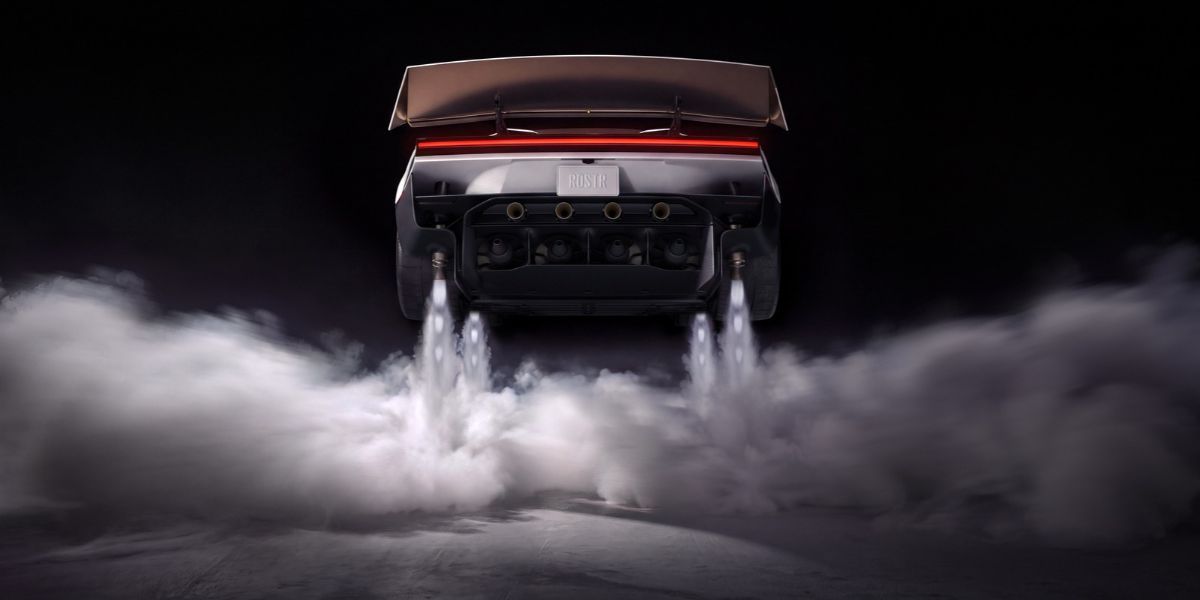
At SpaceX’s rocket development and testing facility in McGregor, Texas, Tesla and CEO Elon Musk finally pulled the covers off the long-delayed second-generation Roadster. What followed was one of the most theatrical product demos in car history: the car used SpaceX-derived cold-gas thrusters to lift off, spin, float over other Tesla vehicles, flip, and land!
Musk has called it “the best of the last of the human-driven cars.”
In the demonstration, a prototype drove up an inverted ramp until it was upside down, used thrusters to spin and stabilise, then floated several feet above a lineup that included a Cybertruck, Tesla Semi, Model Y, and Model 3 before landing. Separate footage showed blistering acceleration, with claims of 0-60 mph (that’s about 96 km/h) in roughly one second (and even faster in certain configurations).
Musk noted afterwards that it worked, and Tesla’s engineering leadership described the capability in simple terms: “flying cars are real”
(at least in controlled conditions)
The system relies on cold-gas thrusters (not combustion rockets) fed by high-pressure compressed air stored in Carbon Fibre Overwrapped Pressure Vessels (COPVs) packed into usable voids throughout the car. Reports and Tesla’s own descriptions point to around 10 nozzles connected to roughly 600 litres of compressed air. The system can be recharged. On higher trims, thrusters provide not just straight-line boost but altitude control, spin, and lateral movement. A multi-mode suction/fan system also generates massive downforce, even helping the car stick when stationary or inverted.
Tesla has listed three configurations:
Performance (road-ready, two seats): Active aerodynamics and multi-mode suction system. 0-60 under 1.6 seconds.
Thrust (race-ready, two seats): Rear-mounted cold-gas thrusters for sub-1-second (or under 0.9-second) 0-60 times.
Rocket (air-ready, single seat, invite-only): Perimeter-mounted thrusters enabling forward and upward acceleration plus rotational movement. Tesla’s own wording: “So… yes, it can fly.” Tesla claims 0-60 in 0.59 seconds, a top speed over 230 mph, and more than 300 miles of range across the lineup. This version is not approved for public road use.
Musk has been clear that this isn’t a safety-optimised vehicle. He has said variations of: if safety is your top priority, don’t buy the Roadster. The company frames it as a halo product—the culmination of close work between Tesla and SpaceX engineers, something “you haven’t seen in any movie, better than any James Bond car.”
The second-generation Roadster was first shown in late 2017, with original promises of deliveries around 2020, a roughly $200,000 starting price, and $50,000 deposits (or $250,000 for a limited Founders Series). Multiple delays followed. Musk has now indicated production is targeted for 2028. Pricing for the new versions is not finalised; reservations are open, with the Rocket trim invite-only. The design has evolved into a sharper, more angular look influenced by aircraft such as the SR-71 and F-35, moving away from the 2017 concept.
The Rocket version is explicitly not road-approved. Range figures are lower than the original version’s 620-mile claim, and the car sits in a luxury hypercar segment where demand for pure EVs has endured setbacks. Musk has previously downplayed its financial impact, describing it more as a statement vehicle while Tesla prioritises autonomy and robotics.
Videos from the livestream and attendee clips spread quickly online, showing the thruster plumes, inverted ramp run, and low-altitude floats.
Is this the start of a new standard of travel?
To see more pictures from the event check out https://www.tesla.com/tesla-gallery