The original promise of the robot vacuum was to basically set it down, walk away, and come back to a sparkling clean home. Yet, for years, the reality has been far less glamorous. Most of us have returned home only to find our supposedly smart robot hopelessly wedged under a bookshelf, choking on a charging cable, or having smeared a mystery spill across the hallway. We bought these things to save time, but often ended up babysitting them.
The new model Robot Vacs are certainly making waves in that area, and DJI’s latest offering is one that wants consideration. This is a company known for making drones and action cameras and has decided in recent years to tackle your living room floor with the global launch of the ROMO 2. And after spending time with this machine, it turns out that putting drone technology into a vacuum makes a whole lot of sense.

Why is a Drone Company Making a Vacuum?
The core challenge of autonomous flight and autonomous cleaning is kind of the same. A machine has to navigate the unpredictable real world without messing up. If DJI’s technology can keep a pricey drone from smashing into a tree at high speed, it can absolutely keep a vacuum from getting stuck on your dining chairs.
The ROMO 2 leverages millimetre-level obstacle sensing powered by the same systems found in DJI’s flagship aircraft. A perception system built from the ground up that can identify and avoid obstacles as thin as 2 mm, like cables or pet training pads. It even mimics human-like reasoning to generalise from what it learns; it can autonomously detect and avoid obstacles it has never seen before, including tricky transparent objects like glass and mirrors that can confuse a robot in the same way it confuses my new puppy.
The Mechanics of the ROMO 2
It is one thing to avoid getting stuck, but a vacuum still has to clean the floor. This is where the ROMO 2 flexes its engineering muscles.
An Arm That Actually Reaches
The standout feature is the LiDAR-guided adaptive robotic arm. Most vacuums struggle with edges and deep corners. The ROMO 2 features an innovative radar-adaptive 123° ultra-wide swing arm that extends out to grab dirt from the places you usually have to clean yourself. It gives the mop a 7.8 cm wider reach and lets it clean 4.5 cm deeper under floating furniture than its predecessor. It glides millimetre-close to walls and table legs without actually bumping into them.
Suction That Means Business
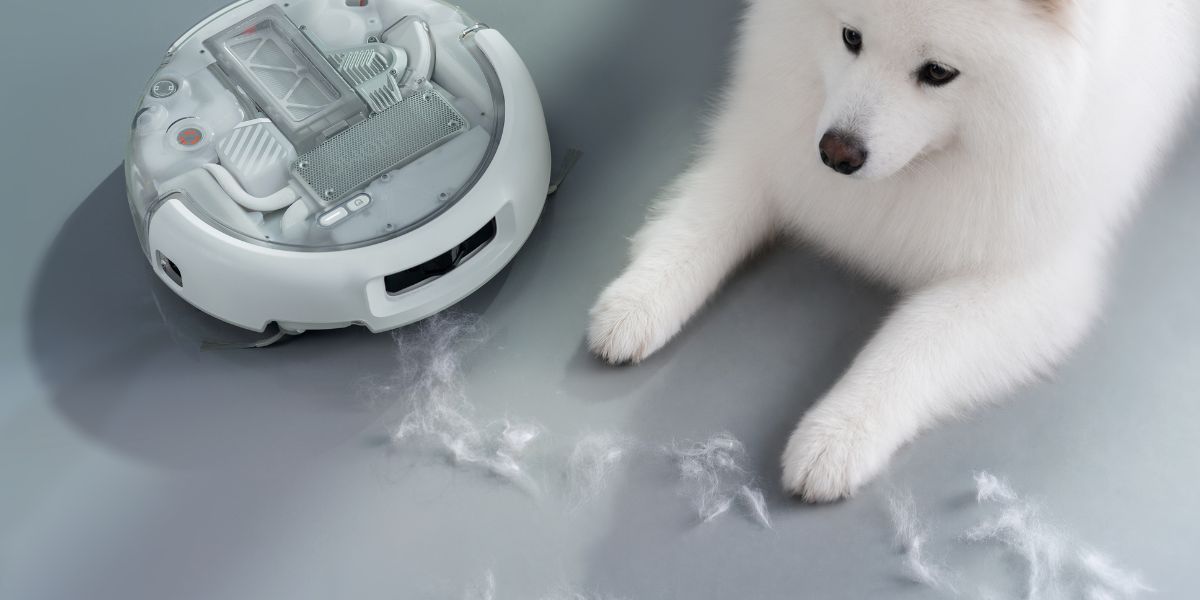
Between a golden retriever constantly shedding blonde hair all over the house, My girls tracking in whatever they find outside, and the tiny bits of plastic filament that always seem to escape my 3D printing desk, my floors are a torture test for any vacuum. The ROMO 2 handles it effortlessly thanks to a staggering 36,000 Pa of suction power.
When the robot detects carpet, a pressure plate lowers to create a semi-seal against the floor, allowing that massive suction to rip out deep-seated dust in a single pass. For the pet hair situation, the dual side brushes use a dual-tuft bristle design that overlaps its sweep coverage. This means smoother debris transfer and, crucially, zero hair tangles.
It is honestly fascinating to watch it work in low-light. Its bottom-mounted dust-revealing light is precisely calibrated to cast an even carpet of light across the floor. This helps the robot clearly spot dirt and obstacles that you’d easily miss in the dark, and its soft glow won’t disturb family members or pets.

It Has Legs (Literally)
One of the most frustrating things about older robots is their inability to cross thick rugs or small steps. DJI fixed this by giving the ROMO 2 dynamic robotic legs. They are small, so don’t expect it to traverse up to the second level of your house, but it can step over single-step obstacles up to 4 cm and double-step obstacles up to 8.5 cm. The mechatronics proactively detect thresholds and smoothly lift the chassis, allowing it to move freely throughout the entire home.
A Base Station You Can Ignore for a Year
The advanced self-cleaning base station is where the magic really happens. The washboard uses a nanocrystalline surface that actively resists stain buildup. When the robot returns, grime is blasted away by four high-pressure water jets and sucked into a massive 16 mm waste port. DJI states this delivers up to 365 days of maintenance-free operation, meaning you can basically forget about cleaning the station for an entire year.
And for those of us working from home or recording audio, noise is a big deal. DJI packed the ROMO 2 with 32 different acoustic noise-reduction materials, reducing noise energy by up to 85%. It operates at a whisper-quiet 38 dBA during quiet mopping, meaning it won’t disturb your calls, your family, or a sleeping dog.
Privacy First
In today’s connected environment, having a camera-equipped robot roaming your house can feel a bit invasive and after the news reports last year of the guy accessing all the robo vacs from his phone DJI has stepped it up a level by offering Local Data Mode for the ROMO 2. When you turn this on, the DJI Home app severs its connection to the internet. This completely prevents any unintentional syncing of photos or videos to external servers. You can disable the camera and microphone directly from the app, and any personal data you do share can be deleted whenever you want. It’s a huge relief and a massive selling point for the privacy-conscious, but at the same time disabling it means losing those cool features. Having that choice is still a good move.
How Does It Stack Up?
Compared to the sea of standard LiDAR-dome vacuums on the market, the ROMO 2 feels like a generational leap almost like the jump from the original Nintendo Switch to Switch 2. Some products might claim smart mapping, but they still rely heavily on bumper contact to feel their way around chair legs. The ROMO 2 doesn’t need to bump; it sees.
The AI-driven, all-scenario cleaning solution understands the characteristics of different areas. It actively distinguishes between dry debris and liquid spills. If you drop a glass of water, most vacuums will just drive straight through it, soaking their brushes and ruining your day. The ROMO 2? It spots the spill, deploys the extended-reach arm for precise, contained cleaning, and prevents the liquid from spreading. It actively prioritises open pathways, re-mops as needed, and automatically lifts its mop pads when appropriate. It just feels a bit smarter than most things I’ve tested.
Romo 2 still has the disposable bags in the hub which can be a bit of an expense unless you go for the non brand ones and then they will likely rip because the quality isnt as good as the DJI ones. There are bagless models from other brands which I’ve used and think is a slightly better solution. The bags are fine to use and having a hassle free option of just throwing the whole bag in the bin is good, its just for every three you throw away its $40 and in this day and age every $40 counts.
The Final Verdict
So, will the DJI ROMO 2 change the way you live? Well. It finally delivers on the original promise of robotic cleaning. The elegant, future-forward design continues ROMO’s signature design language. The robot’s semi-translucent body elegantly reveals its neatly organised internal structure, making it a sexy piece of home décor that doesn’t need to be hidden away in a laundry cupboard. With 55W fast charging, it reaches a full charge in just 2.5 hours and quickly recharges every time it returns to wash its mops.
The DJI ROMO 2 starts at $2899 AUD RRP, but early adopters can snag it for $2399 AUD between September 9 and 30. For a premium model, that’s not a bad price at all. If you are tired of rescuing your old vacuum or cleaning up its mistakes, the ROMO 2 is highly recommended.